Height: Difference between revisions
From Elliptic Curve Crypto
def |
ref |
||
| Line 1: | Line 1: | ||
The '''height''' of a rational number is defined to be the greater of the absolute values of its numerator and denominator in lowest terms. | The '''height''' <ref>Stephen Hoel Schanuel. “Heights in number fields.” ''Bulletin de la S. M. F.'', vol. 107 (1979), p. 433-449. http://www.numdam.org/item/?id=BSMF_1979__107__433_0</ref> of a rational number is defined to be the greater of the absolute values of its numerator and denominator in lowest terms. | ||
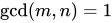
If <math>\gcd(m,n)=1</math>, then <math>H\left(\frac m n\right) = \max(|m|,|n|)</math>. | If <math>\gcd(m,n)=1</math>, then <math>H\left(\frac m n\right) = \max(|m|,|n|)</math>. | ||
Height is used in the method of infinite descent to prove that some property is true of all rational numbers, when it can be shown that the property is true of any rational number whenever it is true of all rational numbers of lesser height. | |||
Revision as of 00:18, 1 January 2025
The height [1] of a rational number is defined to be the greater of the absolute values of its numerator and denominator in lowest terms.
If , then .

Height is used in the method of infinite descent to prove that some property is true of all rational numbers, when it can be shown that the property is true of any rational number whenever it is true of all rational numbers of lesser height.
- ↑ Stephen Hoel Schanuel. “Heights in number fields.” Bulletin de la S. M. F., vol. 107 (1979), p. 433-449. http://www.numdam.org/item/?id=BSMF_1979__107__433_0